A candid conversation with Lovegin John on #CubetRedefined: Rethinking Technology. Redefining Possibilities.
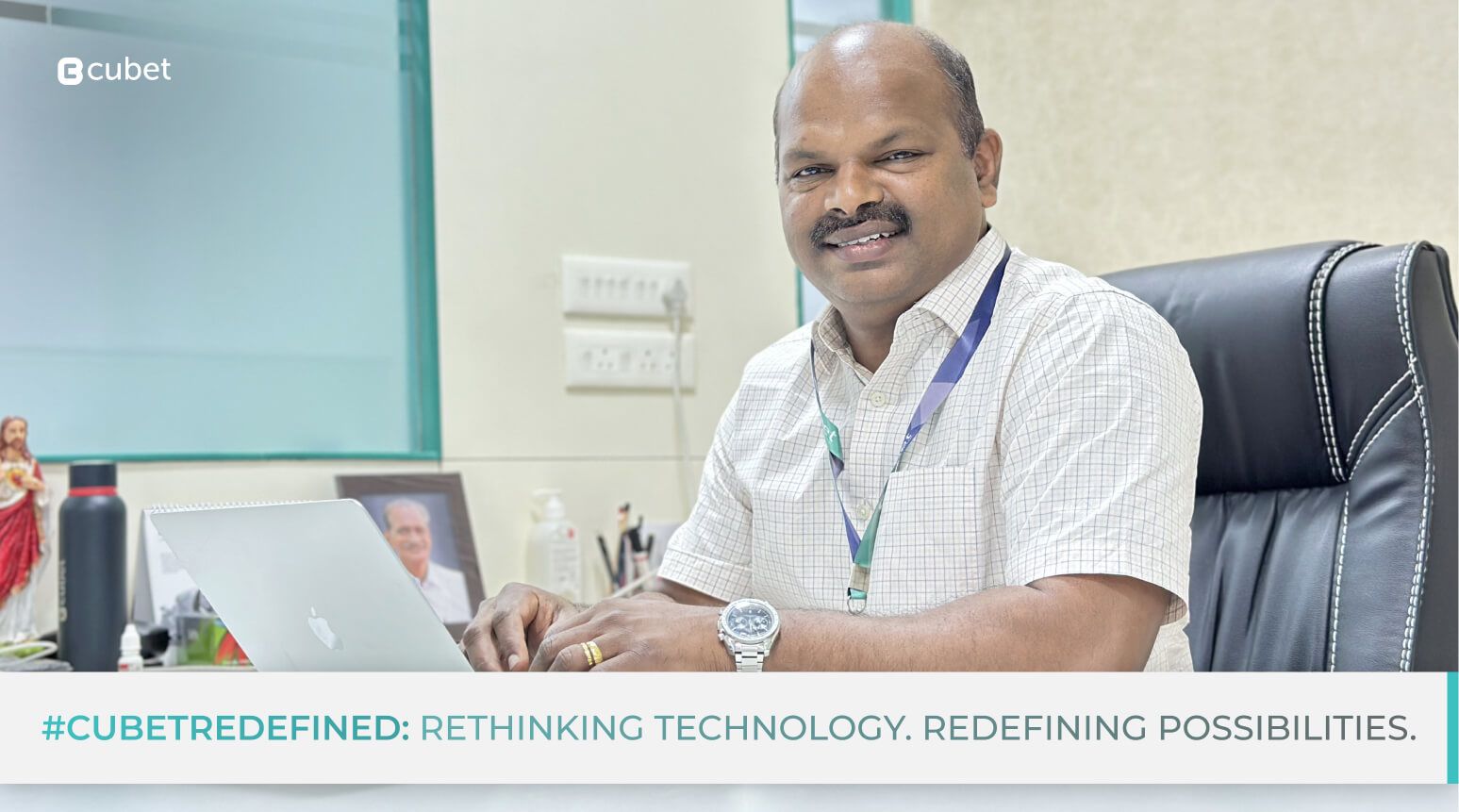
The most revealing conversations about an industry don't happen in boardrooms or keynotes. They happen when a leader steps back and speaks plainly about what's actually changing, what's being overstated, and what it demands of the people building for the future. For Lovegin John, that conversation centers on a single conviction: technology partners can no longer afford to just deliver. They have to think, challenge, and own outcomes. In this conversation, he unpacks what #CubetRedefined means beyond the campaign, why modernisation has become non-negotiable, and how Cubet is choosing to invest while others pull back.
Q: The industry has gone through real disruption recently. What do you think has fundamentally changed for companies like Cubet, for clients, and for the market as a whole?
I see it as a transformation. A fundamental transition in how technology is perceived and used.
The biggest shift is that technology is no longer a support function. It has become central to business survival, competitiveness, and growth.
For companies like Cubet, this means we cannot remain only a delivery partner that builds what is asked. We need to become a thinking partner. Someone who understands business outcomes, brings AI-first ideas, modernises platforms, and helps clients move faster with confidence.
For clients, expectations have changed sharply. They want more than software development. They want efficiency, automation, better decision-making, security, scalability, and measurable impact. They also want innovation done safely, especially around AI, data, and compliance.
For the market as a whole, the old model of simply adding more people to solve problems is weakening. The future belongs to companies that combine strong engineering, domain understanding, AI capability, and outcome ownership.
The fundamental shift is this: technology partners must now create value, not just deliver work.
Q: Is being good at software development still enough? Or has the bar moved to something different entirely?
No. Good engineering is still the foundation, and it will always matter. But the bar has clearly moved.
Clients are no longer looking only for teams who can write clean code or deliver features on time. They expect technology partners to understand their business, challenge assumptions, bring better ideas, reduce risk, and help create measurable outcomes.
Today, a strong technology company must combine engineering depth with AI-first thinking, domain knowledge, security, cloud maturity, DevSecOps, and a product mindset. The question is no longer just whether we can build it. It is whether we should build it this way, whether it can scale, whether it is secure, whether AI can improve it, and whether it will create real value.
So yes, software development still matters. But by itself, it is no longer enough. The future belongs to companies that combine execution with intelligence, accountability, and business impact.
Q: What has changed more over the last few years: technology itself, or client expectations?
Both have changed. But client expectations have shifted even more sharply.
Technology has always been evolving. Cloud, mobile, data, automation, and now AI. These shifts have been continuous. But over the last few years, clients have become far more aware, demanding, and outcome-focused.
Earlier, many clients came with a requirement and expected a technology partner to build it well. Today, they expect us to question the requirement, improve the idea, think about scalability, security, user experience, AI possibilities, cost efficiency, and business impact.
They are also under more pressure themselves. Their customers demand faster digital experiences. Their boards expect efficiency and ROI. Their teams expect automation. And with AI now in the picture, they expect technology partners to bring new thinking, not just technical execution.
So yes, technology has changed. But what has changed more is what clients expect from it, and from partners like us.
Q: How has Cubet's role with clients shifted compared to five years ago?
Five years ago, Cubet's role was largely delivery-focused. Clients came with a requirement, and our responsibility was to build it well, deliver reliably, and support it over time.
That foundation still matters. But today, our role has moved much closer to the client's business thinking. Clients now expect Cubet to participate earlier in the conversation. To understand the business problem, question the approach, suggest better options, and think about scalability, security, automation, AI possibilities, and long-term platform value.
The shift is from execution partner to thinking and transformation partner.
This is especially visible in areas like platform modernisation, DevSecOps, AI adoption, and industry-focused solutions across healthcare, EdTech, and BFSI. Clients do not want technology for the sake of technology. They want clarity, speed, risk reduction, and measurable outcomes.
In many ways, we are becoming more accountable for outcomes, not just delivery.
Q: Many companies pulled back during uncertainty. Cubet invested more. What were you betting on?
We are betting on the future becoming more technology-led, more AI-enabled, and more outcome-driven.
During uncertainty, it is natural to pull back. But I believe the bigger risk is standing still while the market is changing. Clients are under pressure to modernise, reduce cost, improve efficiency, and adopt AI safely. That creates a real opportunity for companies that are prepared.
At Cubet, we invested in AI-first delivery, vertical LLM capability, platform modernisation, DevSecOps, stronger engineering practices, and leadership maturity. We also invested in our people, because technology transformation only succeeds when teams learn, adapt, and take ownership.
Our bet is simple. Clients will increasingly choose partners who bring clarity over confusion, practical innovation over noise, and measurable outcomes over development capacity.
We are not investing because the market is easy. We are investing because the market is changing, and Cubet has to be ready to lead that change.
Q: Modernisation has suddenly become a top enterprise priority. What finally pushed it there?
Modernisation became a priority because legacy systems stopped being just a technical problem. They became a business limitation.
For years, companies managed with older platforms because they were stable, familiar, and already embedded in operations. But the pressure has changed. Businesses now need faster releases, better customer experiences, stronger security, cloud readiness, data visibility, and the ability to adopt AI. Many legacy systems were simply never built for that speed or flexibility.
AI accelerated this urgency significantly. Enterprises are realising that they cannot fully benefit from AI if their data is fragmented, their systems are outdated, or their platforms cannot integrate easily.
What finally pushed modernisation to the top is a simple realisation: delaying it is now more expensive than doing it. Legacy systems may still run, but they quietly slow down growth, innovation, and competitiveness. Enterprises are treating it as a strategic priority now, not just an IT upgrade.
Q: What is the industry overstating about AI right now, and what is it still missing?
I think the industry is overstating AI as a replacement for people, strategy, and strong engineering. There is a lot of noise around AI doing everything instantly, but the reality is that AI creates value only when it is backed by the right context, quality data, secure systems, and clear business goals.
At the same time, many organizations are still missing the foundation needed to make AI truly effective. They talk about AI adoption, but their platforms are outdated, their data is fragmented, their processes are unclear, and their teams are not ready to use AI in a meaningful way.
AI is powerful, but it cannot fix poor thinking, weak architecture, or a lack of ownership.
At Cubet, we approach this through what we call AI³: Intelligence, Innovation, and Impact. Intelligence is about identifying where AI can create genuine business value. Innovation is about leveraging AI to improve the speed, quality, and efficiency of delivery. Impact is about embedding AI into platforms and workflows in ways that are secure, scalable, and sustainable.
The real value of AI will come from applying it responsibly to improve efficiency, decision-making, customer experience, and business outcomes. If the industry is overestimating anything, it is how quickly AI transformation will happen. What is still underestimated is the discipline required to make it successful.
Q: What does OneCubet mean in practice, not as a concept, but in how it shapes the way Cubet works?
OneCubet means we do not work as disconnected teams or individual departments. It means everyone understands that the client experience is shaped by all of us together: sales, delivery, engineering, QA, design, support, leadership, and operations.
For me, OneCubet is about shared ownership. A project should not be seen only as a developer's responsibility, or a project manager's responsibility, or a sales team's responsibility. When a client succeeds, Cubet succeeds. When something goes wrong, we solve it together.
It also means better collaboration, faster communication, more respect between teams, and a stronger focus on the final outcome. Transformation cannot happen in silos.
OneCubet is not just about unity as a nice idea. It is about discipline, accountability, and collective pride in the work we deliver. It is how we make Cubet stronger, more reliable, and more future-ready.
Q: The culture, the people, the way teams work: what does Cubet look like five years from now?
Five years from now, I want Cubet to be a much more mature, confident, and AI-first organisation. But still rooted in the same values that brought us here.
I see Cubet becoming a place where people do not just wait for instructions, but take ownership, think critically, and bring ideas to the table. Teams will work with stronger discipline, better collaboration, and a clearer understanding of business outcomes. AI will be part of everyday work, not as a threat, but as a tool that helps people become faster, sharper, and more valuable.
Culturally, I want Cubet to remain humble, respectful, and people-oriented. Growth should not make us arrogant. It should make us more responsible.
The future Cubet will have stronger leaders at every level, deeper domain expertise, better engineering standards, and a true OneCubet mindset where teams work together instead of in silos.
In simple terms, I want Cubet to be known as a company that combines human commitment with AI-first capability to create real client impact.
Q: So what does #CubetRedefined actually mean to you, beyond the campaign?
To me, #CubetRedefined is not just a campaign. It is a commitment to build the next version of Cubet with more clarity, discipline, and purpose.
It means we are not standing still. The industry is changing, client expectations are changing, and AI is reshaping the way technology is built and used. Cubet has to evolve. Not by losing who we are, but by becoming stronger in the areas that matter most.
Beyond the campaign, #CubetRedefined means becoming an AI-first product engineering and outcomes partner. It means stronger engineering, deeper domain focus, better leadership, more ownership, and a clearer connection between the work we do and the value clients receive.
It also means staying true to our foundation: customer trust, humility, long-term relationships, and team culture.
For me, #CubetRedefined is about building a Cubet that is more future-ready, more accountable, and more valuable to clients, while holding on to the values that brought us here.
Lead. Evolve. Create Impact.
The ideas shared by Lovegin reveal a vision centred on innovation, responsibility, and long-term growth. This commitment to purposeful transformation is helping define what Cubet stands for today and where it is headed next.



Get in touch
Kickstart your project
with a free discovery session
Describe your idea, we explore, advise, and provide a detailed plan.